
In the early morning hours of March 3, a totallunar eclipsewill pass over the United States.
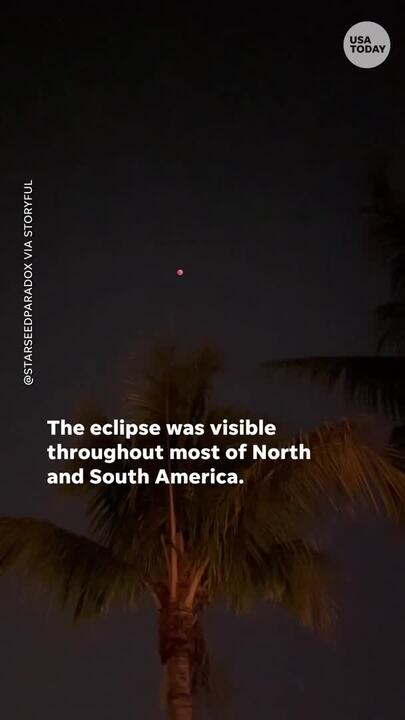
The "blood moon" eclipse will cause the moon to exhibit a reddish hue, according toNASA. It will be visible in parts of the world beginning in the evening and going into the early morning, NASA said.
Here's everything to know about the phenomenon as it approaches.


See stunning images of the 2025 'Blood Moon' and total lunar eclipse
What is a total lunar eclipse?
A lunar eclipse occurs when the Earth passes between the sun and the moon, creating a shadow across the lunar surface, which turns the moon's color reddish-orange. Our planet blocks most of the sun's light from reaching the moon, but the Earth's movement during the eclipse will cause the natural satellite to develop a color.
The moon typically exhibits a grey color because light that reaches the lunar surface is often filtered through Earth's atmosphere.
It's only possible to observe an eclipse during a full moon phase, according to NASA. An eclipse can be observed from anywhere with a direct view of the natural satellite.
Where will the eclipse be visible?
The eclipse will be visible in eastern Asia and Australia in the evening and throughout the night in the Pacific. In the early morning, it will be visible in North and Central America, in addition to far western South America, NASA has said.
Advertisement
In central Asia and much of South America, the eclipse will only be partially visible. There will be no visibility in Africa or Europe.
What time will the eclipse be visible?
Stargazers can observe the eclipse on March 3 from 4 a.m. EST to around 7 a.m. EST, while a partial eclipse will continue until roughly 9 a.m. EST.
Anyone seeking more information on how to view the eclipse, stars and planets can visit NASA'sWhat's Up guide. Binoculars or a telescope are recommended for enhanced views, as is watching the eclipse from a dark environment away from bright lights.
What else is visible during an eclipse?
More:How to view the 2026 'Blood Moon' total lunar eclipse
An eclipse can also make stars and constellations more visible. During the upcoming eclipse, the moon will be in the constellation Leo under the lion's hind paws, according toNASA.
Venus and Saturn will also appear closer to each other in the night sky on March 8.
Michelle Del Rey is a trending news reporter at USA TODAY. Reach her at mdelrey@usatoday.com
This article originally appeared on USA TODAY:Total lunar eclipse is days away. What to know about the 'blood moon'
Post a Comment