GREEN MAG

ShowBiz & Sports Celebs Lifestyle

Hot

10.2.26

PWHL will help grow women's hockey, not diminish US-Canada rivalry

12:22:00 AM
PWHL will help grow women's hockey, not diminish US-Canada rivalry

CORTINA D'AMPEZZO, Italy ―ThePWHLis going to have an impact on the U.S. women's hockey rivalry with Canada.

And that's a good thing.

Between them, the U.S. and Canada have won every world title and Olympic gold medal in women's hockey. The teams, in fact, have faced off in the title game in all but one world championship and one Olympics.

But a sport that's overwhelmingly dominated by one or two teams isn't sustainable – look at softball's struggles to stay in the Olympics. Which is yet another reason thePWHL, currently in its third season, is so important for the women's game.

Japan and France are the only countries in the 10-team Olympic tournament that will not have at least one PWHL player on their roster. The U.S. and Canada have 39 of the league's players between them. There are another 22 spread across the other six European teams, including eight on the Czech Republic's squad.

<p style=The U.S. women's hockey team's pursuit for its first Olympic gold medal since 2018 began with a matchup against Czechia to open the 2026 Winter Games.
Players of Team United States celebrate as Alex Carpenter of Team United States scores a goal past Klara Peslarova of Team Czechia in the first period during the Women's Preliminary Round Group A match between the United States and Czechia during the Milano Cortina 2026 Winter Olympic games at Milano Rho Ice Hockey Arena on February 05, 2026 in Milan, Italy.

" style="max-width:100%; height:auto; border-radius:6px; margin:10px 0;" loading="lazy" /> Alex Carpenter of Team United States scores a goal against Team Czechia in women's ice hockey Group A play during the Milano Cortina 2026 Olympic Winter Games. Megan Keller of Team United States celebrates an assist on a goal with teammates in the first period during the Women's Preliminary Round Group A match between the United States and Czechia. Tereza Plosova of Team Czechia skates with the puck against Caroline Harvey of Team United States in the second period during the Women's Preliminary Round Group A match between the United States and Czechia. Joy Dunne of Team United States scores a goal past Klara Peslarova of Team Czechia in the second period during the Women's Preliminary Round Group A match between the United States and Czechia. Joy Dunne of Team United States celebrates after scoring a goal against Team Czechia in women's ice hockey Group A play. Klara Peslarova of Team Czechia defends the net against Hayley Scamurra of Team United States in the second period during the Women's Preliminary Round Group A match between the United States and Czechia. Klara Peslarova of Team Czechia reacts after allowing a goal to Hayley Scamurra of Team United States in the second period during the Women's Preliminary Round Group A match between the United States and Czechia. Hayley Scamurra of Team United States celebrates with teammates after scoring a goal against Team Czechia in the second period during the Women's Preliminary Round Group A match between the United States and Czechia. Lee Stecklein of Team United States skates with the puck in the second period during the Women's Preliminary Round Group A match between the United States and Czechia. Barbora Jurickova of Team Czechia scores a goal past Aerin Frankel of Team United States in the second period during the Women's Preliminary Round Group A match between the United States and Czechia. Barbora Jurickova of Team Czechia scores a goal past Aerin Frankel of Team United States in the second period during the Women's Preliminary Round Group A match between the United States and Czechia. Aerin Frankel of Team United States looks on in net in the second period during the Women's Preliminary Round Group A match between the United States and Czechia. Hilary Knight of Team United States skates with the puck defended by Natalie Mlynkova of Team Czechia in the second period during the Women's Preliminary Round Group A match between the United States and Czechia. Hilary Knight of Team United States scores a goal in the second period during the Women's Preliminary Round Group A match between the United States and Czechia. Hilary Knight of Team United States scores a goal past Klara Peslarova of Team Czechia in the second period during the Women's Preliminary Round Group A match between the United States and Czechia. Hilary Knight of Team United States scores a goal past Klara Peslarova of Team Czechia in the second period during the Women's Preliminary Round Group A match between the United States and Czechia. Hilary Knight of Team United States celebrates with Alex Carpenter and other teammates after scoring a goal against Team Czechia. Abbey Murphy of Team United States tries to get the puck past Klara Peslarova of Team Czechia in women's ice hockey Group A play. Hayley Scamurra of Team United States celebrates a goal in the third period during the Women's Preliminary Round Group A match between the United States and Czechia. Hayley Scamurra of Team United States celebrates scoring a goal past Klara Peslarova of Team Czechia in the third period during the Women's Preliminary Round Group A match between the United States and Czechia. Hayley Scamurra of Team United States celebrates after scoring a goal in the third period against Team Czechia in women's ice hockey Group A play.

See Team USA women's hockey dominate vs. Czechia at Winter Olympics

TheU.S. women's hockey team's pursuit for its first Olympic gold medal since 2018 began with a matchup against Czechia to open the2026 Winter Games.Players of Team United States celebrate as Alex Carpenter of Team United States scores a goal past Klara Peslarova of Team Czechia in the first period during the Women's Preliminary Round Group A match between the United States and Czechia during the Milano Cortina 2026 Winter Olympic games at Milano Rho Ice Hockey Arena on February 05, 2026 in Milan, Italy.

More:The PWHL Effect: Why Olympic women's hockey looks different in 2026

Six of those players will be making their Olympic debut with another 10 playing at their second Winter Games.

"The gap is closing, and I think the role that the PWHL is going to play is going to be a big one," said Kendall Coyne Schofield, one of the architects of the PWHL and a mainstay on the U.S. team.

"Especially after this (Olympic) cycle, I think you'll start seeing players come over here and say, 'I want to play with the best. I need to play with the best in order to be the best,'" Coyne Schofield said. "Having all the best players under one roof is only going to elevate the game in a way that is going to close the gap among countries."

It's what has happened in other sports.

The NWSL, WNBA and NCAA have fueled growth in soccer and basketball. Individual players from countries where the sport is less established go abroad and get better, encouraging other players to make a similar move. That, in turn, lifts the level of the national team.

Take Germany's basketball team. It has sent an increasing number of players to the WNBA and NCAA in recent years, including the New York Liberty's Leonie Fiebich and Nyara Sabally, Satou Sabally of the Phoenix Mercury and the Dallas Wings' Luisa Geiseloeder.

The Paris Olympics were Germany's first. It reached the quarterfinals.

The PWHL can have a similar impact. Already has, actually.

The Czech Republic did not qualify for the top division at the world championships until 2012 and did not win a knockout round game until 2022. That year, however, the Czechs won the first of two consecutive bronze medals at worlds. They've been fourth the last two years.

The difference? Almost half the players on the Czech roster are now from either the PWHL or NCAA programs, including Kristýna Kaltounková, the first pick in last year's PWHL draft. Their coach since 2022 is Carla MacLeod, whose "day job" is coach of the PWHL's Ottawa Charge.

"They've put resources behind their program," Coyne Schofield said. "There's no secret formula here. Give the players the tools they need to be successful and they will be successful. We're able to do that professionally. Now it's replicating that internationally throughout all the federations and you'll see that gap close. Real quick."

Finland and Sweden, which have four PWHL players each on their rosters, have also made strides, said U.S. captain Hilary Knight, who helped found the league.

"It kind of goes across the board," Knight said. "That's extremely exciting when you take a 30,000-foot viewpoint of women's hockey on where it can go and the trajectory of the sport and how far it's come in just a small time that we've been involved."

While other teams getting better could mean the U.S. and Canada don't dominate the way they consistently have, players are more than fine with that. They want women's hockey to grow, and other countries getting better makes the entire game better.

Besides, no matter how much the game grows or how many other teams become medal contenders, U.S.-Canada is always going to be THE rivalry. A bitter one, at that.

"They don't like us very much," Caroline Harvey, a two-time U.S. Olympian said. "(We) don't like them, either."

This article originally appeared on USA TODAY:PWHL is key to growing women's hockey, making game stronger

Read More

9.2.26

Why Israel's ballistic missiles demand could upend US-Iran talks

11:42:00 PM
Why Israel's ballistic missiles demand could upend US-Iran talks

As the United States hangs on the precipice of a military attack on Iran whilenegotiating a nuclear dealthat would avert a strike, Israel wants the Trump administration to insist on limits on Iran's ballistic missile stockpiles and funding of militant groups, demands that experts say could cause a stalemate in the talks and lead to war.

USA TODAY

PresidentDonald Trumptold reporterson Feb. 6 that a deal that only saw Iran commit to eliminate its nuclear weapons, with no other concessions, would be "acceptable."

"Right up front, no nuclear weapons," Trump added.

Iran has expressed openness to a deal if it only involves nuclear issues.

<p style=Anti-government protests in Iran appeared to accelerate on Jan. 9, sparked by anger over the collapse of the country's currency and a broader sense of hopelessness and disillusionment with Tehran's clerical leaders.

The uptick in unrest also comes as President Donald Trump warned Iran's authorities against killing peaceful protesters, saying Washington "will come to their rescue."

See the scenes in Iran, beginning here on the streets amid anti-government unrest in Tehran, Iran, in this still image obtained from social media video released on January 8, 2026. Witnesses told Reuters protesters gathered in the streets on Thursday, January 8, however this video's date taken has not been verified.

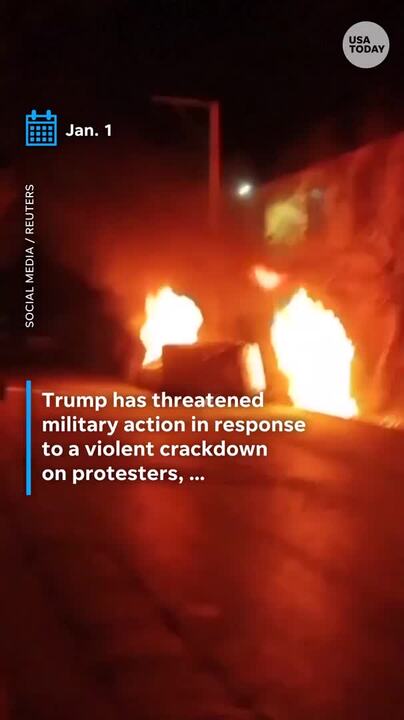
" style="max-width:100%; height:auto; border-radius:6px; margin:10px 0;" loading="lazy" /> Protesters gather as vehicles burn, amid evolving anti-government unrest, in Tehran, Iran, in this screen grab obtained from a social media video released on January 9, 2026. People tear down an Iranian flag after it was taken down in Mashhad, Razavi Khorasan Province, Iran, in this still image obtained from a social media video released on January 8, 2026. Date when the video was filmed could not be confirmed. An overturned car and multiple fires burn as protesters chant outside a police station, during Iran's biggest demonstrations in three years over economic hardship, in Azna, Lorestan Province, Iran, in this still image obtained from a social media video released on January 1, 2026. Protesters gather amid evolving anti-government unrest in Tehran, Iran, in this screen grab obtained from a social media video released on January 9, 2026. Witnesses told Reuters protesters gathered in the streets on Thursday, January 8, however this video's date taken has not been verified. People gather on the streets amid anti-government unrest in Tehran, Iran, in this still image obtained from social media video released on January 8, 2026. The date of the videos could not be verified. Witnesses in Tehran told Reuters that protesters gathered in the streets on Thursday, January 8. People gather on the streets during a protest in Mashhad, Razavi Khorasan Province, Iran in this screengrab obtained from a social media video released on January 8, 2026. The date could not be verified but multiple videos verified to Mashhad were posted online on January 8. Iranian Foreign Minister Abbas Araqchi speaks during a press conference in Beirut, Lebanon, January 9, 2026. Burning debris lies in the middle of a street during unrest in Hamedan, Iran on January 1, 2026. The demonstrations erupted after shopkeepers in Tehran's Grand Bazaar shut their businesses to protest the sharp fall of Iran's currency and worsening economic conditions, with clashes reported in several provinces and Iranian media and rights groups saying multiple people were killed in the violence, marking the largest protests to hit the Islamic Republic in three years. A person uses a lighter to set fire to a banner during demonstrations in Hamedan, Iran, on January 1, 2026. The demonstrations erupted after shopkeepers in Tehran's Grand Bazaar shut their businesses to protest the sharp fall of Iran's currency and worsening economic conditions, with clashes reported in several provinces and Iranian media and rights groups saying multiple people were killed in the violence, marking the largest protests to hit the Islamic Republic in three years. Burning debris lies next to an overturned dumpster in the middle of a street during unrest amid demonstrations in Hamedan, Iran, on January 1, 2026. The demonstrations erupted after shopkeepers in Tehran's Grand Bazaar shut their businesses to protest the sharp fall of Iran's currency and worsening economic conditions, with clashes reported in several provinces and Iranian media and rights groups saying multiple people were killed in the violence, marking the largest protests to hit the Islamic Republic in three years. Rocks, tree branches, and a toppled charity box remain on a street during unrest amid demonstrations in Hamedan, Iran, on January 1, 2026. The demonstrations erupted after shopkeepers in Tehran's Grand Bazaar shut their businesses to protest the sharp fall of Iran's currency and worsening economic conditions, with clashes reported in several provinces and Iranian media and rights groups saying multiple people were killed in the violence, marking the largest protests to hit the Islamic Republic in three years. A protester flashes victory signs as traffic slows during demonstrations in Hamedan, Iran, on January 1, 2026. The demonstrations erupted after shopkeepers in Tehran's Grand Bazaar shut their businesses to protest the sharp fall of Iran's currency and worsening economic conditions, with clashes reported in several provinces and Iranian media and rights groups saying multiple people were killed in the violence, marking the largest protests to hit the Islamic Republic in three years. Security forces detain protesters outside a commercial building on Ahmadabad Street in Mashhad, Iran on January 3, 2026. Iran has experienced recurrent waves of protests in recent years driven by political repression, economic hardship, rising living costs, and restrictions on civil and social freedoms, including women's rights. Demonstrations have frequently been met with arrests, heavy security deployments, internet disruptions, and, according to activists and rights groups, the killing of protesters, as authorities move to suppress dissent. People walk down the street, chanting in Farsi, Demonstrators attempt to force a gate open to gain access to a building during a protest in Fasa, Iran, in this still image obtained from a social media video released on December 31, 2025.

See Iran's anti-government protests, huge crowds, unrest in photos

Anti-government protests in Iranappeared to accelerate on Jan. 9, sparked by anger over the collapse of the country's currency and a broader sense of hopelessness and disillusionment with Tehran's clerical leaders.

The uptick in unrest also comes as PresidentDonald Trumpwarned Iran's authorities against killing peaceful protesters, sayingWashington "will come to their rescue."See the scenes in Iran, beginning here on the streets amid anti-government unrest in Tehran, Iran, in this still image obtained from social media video released on January 8, 2026. Witnesses told Reuters protesters gathered in the streets on Thursday, January 8, however this video's date taken has not been verified.

"We do not discuss any other issue with the U.S.," Iranian Foreign Minister Abbas Araqchi said after the first day of talks between U.S. and Iranian negotiators in Oman on Feb. 6, which he called a "good start."

That red line puts the high-stakes negotiations on a collision course with Israel, which has insisted that Iran's ballistic missiles and its military support for its proxy forces in the region, such as Hamas and Hezbollah, must also be on the table.

Israeli Prime MinisterBenjamin Netanyahuis coming to Washington, DC on Feb. 11, where he is expected to push Trump to hold Iran to those additional conditions. Netanyahu "believes any negotiations must include limitations on ballistic missiles and a halting of the support for the Iranian axis," his office said in a Feb. 8statement.

The United States dropped more than a dozen penetrating bombs onIran's nuclear facilitiesin June 2025. Trump hasrenewed his threatsto reattack in recent weeks, amid the largest protests Iran has seen in decades and a brutal government crackdown in response that has killed thousands.

Ballistic missiles key to Iran's defense

The problem with those non-nuclear demands, according to experts, is that they would require Iran to completely restructure its national security strategy and decades of its defense dogma.

"The ballistic missile program is a key pillar of Iranian defense strategy," said Brian Carter, a research manager at the American Enterprise Institute's Critical Threats Project, who is focused on Iran and its regional partners. "For the Iranians to agree to a condition (limiting it) would be tantamount to a complete rethink of Iranian security policy over the last 10 years or longer than that."

"I don't know what exactly the United States is looking for in terms of limits, but it's an unrealistic expectation," he said.

It's not clear what kind of limit Israel wants to impose on Iran's ballistic missile stockpiles – whether on the number of missiles it could maintain or on the range that the missiles could reach. Iran has both medium-range ballistic missiles, which can reach around 620 to 1,860 miles, and short-range ballistic missiles, which cover a range less than that.

Advertisement

More:US military shoots down Iranian drone that 'aggressively' approached ship

From Iran's perspective, a limit on missile range would be akin to "taking our ability to retaliate and deter Israel while they have no limit on their ability to attack us," said Jim Lamson, a senior research associate at the Middlebury Institute's James Martin Center for Nonproliferation Studies.

A cap on the range of Iran's medium-range ballistic missiles, which can reach Israel, would also not address the risk posed to U.S. bases in the region, which Iran can reach with its short-range missiles. There are at least 40,000 U.S. troopsstationedin the region, as of June of last year, which would be a prime target for Iran's retaliation, if attacked.

"It would not be possible to attack American soil, but we will target their bases in the region" if attacked, Araqchi said on Feb. 6.

Iran's reliance on ballistic missiles as the central pillar of its military strategy dates back to its war with Iraq in the 1980s. "They learned the hard way," Lamson said.

Experts say Iran's ballistic missiles are a key pillar of its defense strategy.

In the years since, Iran built up an "asymmetric" military strategy that centers on ballistic missiles and regional forces and "exploits our defense posture and hits us where we have gaps," according to Carter.

Carter and Lamson both likened a U.S. demand for Iran to give up its ballistic missiles to asking the United States to give up its aircraft carriers – a central facet of American military force and defense strategy. Trumphas dispatchedone of the country's aircraft carriers, the USS Abraham Lincoln, along with its three accompanying warships, to the Middle East amid his threats to attack Iran.

Even if Iran agreed on a limit to its ballistic missile capabilities, verifying its compliance would present an additional set of challenges, Lamson said.

"There's no way" Iran would accept the "intrusive monitoring and verification of ballistic missile development and production facilities" necessary to keep tabs on that limit, he added.

Iran's missile arsenal degraded, but unclear how much

While Israel's attack on Iran during the 12-Day War last June significantly degraded its ballistic missile stockpiles, it's not clear how much Iran has been able to replenish its arsenal.

Gen. Kenneth McKenzie, then the commander of U.S. Central Command,told senatorsin 2022 that Iran had more than 3,000 ballistic missiles. Iranfired370 missiles at Israel during the war last June, around a half to a third of its stockpile, leaving it with around 1,500 missiles left, according to Israeliestimates.

This article originally appeared on USA TODAY:Israel wants ballistic missile limits. Iran won't budge. Is it war?

Read More

China’s Lunar New Year travel rush begins with record 9.5 billion trips expected

11:42:00 PM
China's Lunar New Year travel rush begins with record 9.5 billion trips expected

BEIJING (AP) — Liu Zhiquan was waiting for a 30-plus hour train journey to Chengdu, the capital of Sichuan province, some 1,242 miles (2,000 kilometers) from Beijing, where he works in construction.

Associated Press A traveler eats while waiting inside a railway station as people return home during the Lunar New Year holiday in Beijing, China, Tuesday, Feb. 10, 2026. (AP Photo/Vincent Thian) A man runs while pulling a suitcase at a railway station as people return home during the Lunar New Year holiday in Beijing, China, Tuesday, Feb. 10, 2026. (AP Photo/Vincent Thian) Two high-speed trains travel along parallel tracks in Beijing, China, Tuesday, Feb. 10, 2026. (AP Photo/Vincent Thian) Passengers crowd a concourse at a railway station as they return home during the Lunar New Year holiday in Beijing, China, Tuesday, Feb. 10, 2026. (AP Photo/Vincent Thian) Suitcases are stacked as passengers wait at a railway station while returning home during the Lunar New Year holiday in Beijing, China, Tuesday, Feb. 10, 2026. (AP Photo/Vincent Thian)

APTOPIX China New Year Travel

He's one of the hundreds of millions expected to travel to their hometowns as part of the world's largest movement of humanity, or "chunyun" as it's called in China, ahead of the Lunar New Year on Feb. 17.

"Things feel worse this year than last. The economy is bad and it's getting harder to make money," he said.

Liu chose a slower train to save money: a high-speed train would take just nine hours but costs more than twice as much.

Nonetheless, he chose to make the 30-hour journey to be home for the festival, the one time of year workers across the country take breaks and spend time with their loved ones.

Advertisement

China's government estimates that 9.5 billion trips will be made during the 40 day-period around the festival, a record high, according to information from the National Development and Reform Commission. Some 540 million of those trips will be made via train, and 95 million by air. The rest will be on the road.

In a country where workers are expected to put in long hours — including on weekends — and get few days of annual leave, the Lunar New Year festival is a precious time.

At a train station in Beijing, passengers were crowded in the waiting areas with large bags and suitcases as they waited for their trains. Others snacked on instant noodles, an easy snack as stations provide hot water for free.

Tian Duofu, a young woman who recently started working full time in Beijing, said she was looking forward to the nine-day holiday, which begins Feb. 15. "It has become more difficult for a big family to get together. After I started working, I realized such a long holiday is rare and we see each other less and less in person, which makes the Spring Festival significant."

"The new year is the festival of the year, and if we don't go back home, we won't be able to enjoy the festival atmosphere," said Tian Yunxia, a woman from Henan province who runs a breakfast stall in Beijing. "I want to go home to see my children, my grandchildren and my husband."

Read More